Thursday, March 31, 2011
Out and About: Boston University Art Gallery
Sunday, February 27, 2011
A Bunch of Shit Was Harmed in the Making of Destrukto

Image courtesy of Howard Yezerski Gallery
They’re a far cry from the documentary photos Burke is most well known for; the horrific results of war and poverty in Southeast Asia, Appalachian coal mining towns and the people that call them home, and are the artist’s furthest journey into the space where photography and performance art meet.
Destrukto is on view at Howard Yezerski Gallery, Boston until Tuesday, March 15.
Go here for gallery hours, location, etc.
Sunday, January 23, 2011
Out and About: A Week in Review
A founder of the conceptual art movement, Lawrence Weiner uses text to challenge traditional assumptions viewers may have about an object. Phrases such as “Pushed Forward/ Close By/ Pushed Aside/ Close By/ With Graceful Haste” line an S-shaped wall constructed in the north gallery of Marian Goodman as part of the artist's most recent gallery show, Gyroscopically Speaking.
The bold, curving lines that accompany most of Weiner’s pieces in the show are a tool to manipulate the viewer’s eye, the most basic goal of any visual art work. These lines also allow the viewer to maintain a sense of orientation (hence, the gyroscope) while interpreting the text. However, the phrases Weiner presents remain open to individual interpretation, and that fundamental relationship between what is being presented and how it is being interpreted is the most significant aspect of Weiner’s work.

Lawrence Weiner, TAKEN FROM THE WIND & BOLTED TO THE GROUND, 2009, LANGUAGE + MATERIALS REFERRED TO. Courtesy of the artist and Marian Goodman Gallery, New York and Paris
Mark Bradford
Contemporary art superstar Mark Bradford is the subject of the ICA’s latest blockbuster exhibition, Mark Bradford. It's also the first survey exhibition of the Los Angeles based artist’s work which consistently explores race, class and gender in American urban society. Organized by the Wexner Center for the Arts, Ohio State University, Mark Bradford includes installation, video, sculpture and the collage paintings the artist is most famous for.
Thursday, December 23, 2010
When I Have Time Off, I Look at Art and Drink.
New York
What I Saw:
John Baldessari: Pure Beauty
Oct. 20, 2010 – Jan. 9, 2011
Metropolitan Museum of Art
The most extensive retrospective to date of Los Angeles-based artist John Baldessari, Pure Beauty is an exceptionally organized show, offering highlights from every decade of the conceptualist artist’s career. His early use of text, photography and film and the underlying theme of “What makes art, art?” has influenced countless contemporary artists, apparent in the works of Cindy Sherman and Jenny Holzer.
Standout Piece:
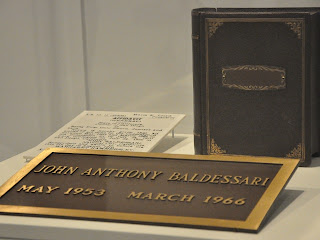
In 1970, frustrated with the limitations of his previous work, John Baldessari burned pieces he created between 1953 and 1966. “Cremation Project,” as it became to be known, was not only a disavowal of his previous life as a painter and what came of his efforts, but a definitive moment in Baldessari’s transition towards a more hands-off approach in creating art.
Image courtesy of DNAinfo/Jennifer Glickel
Pure Beauty was organized by LACMA in association with Tate Modern. It is on view at the MET until Jan. 9, 2011. For more information go here.
What I Drank:
Vodka. And a lot of it. I spent Friday night at a big gay toys for tots benefit and it was open bar. Enough said.

What I Thought:
“Cremation Project” is a lasting testament to the transition in Baldessari’s career and creative process. Maybe the piece resonated so much because I’m in the process of my own career transition. And who hasn’t wanted to burn it all to the ground before.
Dallas
What I Saw:
The Dallas Museum of Art
My first time to the DMA, I was extremely impressed with the facilities, the diversity of the permanent collection and the breadth of community programming.
For visitor information, go here.
Standout Pieces from Re-Seeing the Contemporary (Oct. 15, 2010 - March 20, 2010):
David Szafranski's “Is it Fear or Desire” and Alan Saret's "Deep Forest Green Dispersion"
Deep Forest Green Dispersion, 1969, Alan Saret, American Galvanized hex netting, painted,Dallas Museum of Art, gift of John Weber
What I Drank:
What didn’t I drink?! Delicious margaritas at an excellent authentic Mexican restaurant, bottle after bottle of assorted red wines (bought in a slightly dream like shopping spree at Costco) and Miller Light. From a bottle and from a keg.
What I Thought:
Texas gets a bad rap.
Monday, December 6, 2010
David Wojnarowicz’s "A Fire in My Belly" On View At The New Museum
Monday, November 29, 2010
The House that Malcolm Built
Ruth and Carl J. Shapiro Family Courtyard © Chuck Choi. Image courtesy of the Museum of Fine Arts, Boston
About ten years ago, well known (infamous, to some) MFA Director Malcolm Rogers began to build support for the expansion, eventually raising $504 million for the new wing. Criticized in the past for his staff overhauls and controversial exhibits, you can feel Roger’s fingerprint throughout the new wing, which will undoubtedly serve as a lasting reminder of his tenure at the MFA.
Designed by London based architectural firm Foster + Partners, the 133, 491 square foot addition houses more than 5,000 pieces from North, South and Central America in 53 galleries. As you ascend the four floors, you are also moving forward in time. The lower ground level consists of a relatively small collection of Pre-Colombian, Andean and Native North American art along with pieces from 17th century New England. Level one and two takes visitors through American Colonialism, American Impressionism and beyond. These two levels showcase what the MFA is most well known for; it’s expansive collection of 18th and 19th century American art and artifacts. Iconic works by John Singer Sargent, John Singelton Copley, Thomas Sully, Samuel McIntire, Winslow Homer and Louise Comfort Tiffany are all on view, and not to be missed by any visitor to Boston.
The Passage of the Delaware, Thomas Sully. Museum of Fine Arts, Boston. Gift of the Owners of the old Boston Museum. Photograph © Museum of Fine Arts, Boston
In sharp contrast to the breadth of work exhibited on floors two and three, the fourth floor consists of a poor collection of modern American art. Although it houses several pieces by Goergia O’Keefe and Arthur Dove, the MFA’s holdings in this category are rather dismal. In a review of the wing, Boston Globe Art Critic Sebastian Smee described the offerings on the fourth floor as “blowsy and third-rate,” a fair assessment in my eyes.
Despite the disappointment the fourth floor provided, the new wing is highly impressive. It transforms the entire visitor experience at the MFA, highlights collection strengthens and embraces where Mr. Rogers and the rest of the MFA staff need to focus acquisition efforts.
For visitor information go here.
Editorial Disclaimer: The author of this post received discounted or complementary admission to the above mentioned exhibition, courtesy of the host institution, organization or gallery.
Monday, November 22, 2010
"The Whitney Announces Curators for 2012 Biennial"
Read all about it here.