Sunday, June 5, 2011

A Useful Way to Use All These Bottle Tops. FINALLY!

In 2002, while out on a walk, artist El Anatsui found what would become his most recognizable artistic medium…thousands of metal liquor bottle tops. “When I first found the bag of bottle tops, I thought of the objects as links between Africa and Europe,” Anatsui has said. “For me, the bottle caps have a strong reference to the history of Africa.” Over the past decade, Anatsui, a Ghanian who has taught and worked in Nigeria since the late 70’s, has created an extensive body or work which utilizes these tops. Recognized as one of the most influential and notable contemporary African artists, these installations anchor Anatsui’s first career retrospective now on view at the Davis Museum at Wellesley College.

Organized by the Museum of African Art, New York, When I Last Wrote to You about Africa, showcases Anatsui’s ability to create pieces from a variety of surprising materials that are both beautiful and serve as critiques on modern social and political life in Africa. His bottle top sculptures exist as tapestries, huge shiny, booze stained tapestries. “The liquor bottle tops and labels have something in common with the Ghanain practice of naming textiles. The names given to textiles and drinks reveal a lot about the culture and, at times, the history of a place. The bottle tops were introduced by European traders, and alcohol was one of the commodities they brought with them to exchange for African goods.”

Sacred Moon, 2007, aluminum and copper wire, 103 x 141 inches. Image courtesy of Jack Shainman Gallery.

When I Last Wrote to You about Africa will be on view at the Davis Museum until June 26. For more information, go here. To see more of Anatsui's work, go here.

Wednesday, April 6, 2011

Steaming Piles of Polyurethane: This is Why I Love Lynda

Often overlooked, always avant-garde, artist Lynda Benglis began her career in New York as a painter at the height of the minimalist movement. In 1968, she began creating her “Fallen Paintings” by pouring latex directly onto the floor. Now, 40 years later, just steps from the studio at 222 Bowery she has occupied since the 70’s, the most iconic piece from this creative period, Contraband, is on display in the lobby of the New Museum.


Image courtesy of the New Museum


The sculptural work for which Benglis is most well known, and the anchor of this retrospective, is minimalist in medium (polyurethane, wax, aluminum etc.) but executed in an abstract expressionist style. It’s easy to see Jackson Pollack’s influence in her pieces; the pigmented latex being applied to the floor the same way Pollack dripped house paint on canvas to create his iconic action paintings 20 years prior.


These pieces were also Benglis’s first attempts to disrupt the male dominated minimalist movement. Experimentation with photography and film and heightened feelings of underrepresentation led Benglis to take out an advertisement(NSFW!) in Artforum in 1974, where she posed nude with an extra large, lifelike latex dildo between her legs. Although the advertisement is now viewed as an important statement on gender in contemporary art, it brought Benglis much criticism from the feminist community (her creative insecurities led to this over-the-top gesture). A number of Benglis’s pieces that challenge sexuality and gender are the highlights of this show.


However significant her work has been to contemporary art on a conceptual level, Benglis’s pieces are most importantly exciting, comical and fun to engage with. Benglis created Phantom in 1971 by making amateurs of chicken wire covered in plastic and then by pouring phosphorescent polyurethane over them. The glow-in-the-dark figures appear to be emerging from the wall, the finger tips of a monster slowly transitioning into this dimension. Authors note – DO NOT SMOKE WEED IMMEDIATELY BEFORE SEEING THIS SHOW!


Image courtesy of the New Museum


Lynda Benglis was organized by the Irish Museum of Modern Art, Dublin, in collaboration with Van Abbemuseum, Eindhoven; Le Consortium, Dijon; The Museum of Art, Rhode Island School of Design, Providence; and the New Museum, New York. The exhibition is on view at the New Museum until June 19. For more information go here.


Editorial Disclaimer: The author of this post received discounted or complementary admission to the above mentioned exhibition, courtesy of the host institution, organization or gallery.

Thursday, March 31, 2011

Out and About: Boston University Art Gallery


Well curated and installed, it was refreshing to learn about three artists and an artistic center that I was ignorant to.

Adapted from the offical press release:

This exhibition features the work of three South African artists who were important participants in the early years of The Caversham Press. Comprising over 65 prints, the exhibition features selections from three collaborative print portfolios—Hogarth in Johannesburg, Little Morals, and Ubu Tells the Truth—as well as individual prints created by Bell, Hodgins and Kentridge at Caversham from 1985 to the present. Collectively, the work reflects Caversham’s beginnings as well as articulates the artists’ perspectives of living and working in South Africa during the years between late apartheid and the transition to the new democracy.

Sunday, February 27, 2011

A Bunch of Shit Was Harmed in the Making of Destrukto

McDonald’s hamburgers, computer monitors and cans of Budweiser all met their fate at the hands of artist Bill Burke in the making of Destrukto, a series of photographs that document inanimate objects being shot. With a gun. And a camera.

Image courtesy of Howard Yezerski Gallery

They’re a far cry from the documentary photos Burke is most well known for; the horrific results of war and poverty in Southeast Asia, Appalachian coal mining towns and the people that call them home, and are the artist’s furthest journey into the space where photography and performance art meet.

Destrukto is on view at Howard Yezerski Gallery, Boston until Tuesday, March 15.

Go here for gallery hours, location, etc.

Sunday, January 23, 2011

Out and About: A Week in Review

Lawrence Weiner
Gyroscopically Speaking
Marian Goodman Gallery

A founder of the conceptual art movement, Lawrence Weiner uses text to challenge traditional assumptions viewers may have about an object. Phrases such as “Pushed Forward/ Close By/ Pushed Aside/ Close By/ With Graceful Haste” line an S-shaped wall constructed in the north gallery of Marian Goodman as part of the artist's most recent gallery show, Gyroscopically Speaking.

The bold, curving lines that accompany most of Weiner’s pieces in the show are a tool to manipulate the viewer’s eye, the most basic goal of any visual art work. These lines also allow the viewer to maintain a sense of orientation (hence, the gyroscope) while interpreting the text. However, the phrases Weiner presents remain open to individual interpretation, and that fundamental relationship between what is being presented and how it is being interpreted is the most significant aspect of Weiner’s work.


Lawrence Weiner, TAKEN FROM THE WIND & BOLTED TO THE GROUND, 2009, LANGUAGE + MATERIALS REFERRED TO. Courtesy of the artist and Marian Goodman Gallery, New York and Paris

Mark Bradford

The Institute of Contemporary Art, Boston

Contemporary art superstar Mark Bradford is the subject of the ICA’s latest blockbuster exhibition, Mark Bradford. It's also the first survey exhibition of the Los Angeles based artist’s work which consistently explores race, class and gender in American urban society. Organized by the Wexner Center for the Arts, Ohio State University, Mark Bradford includes installation, video, sculpture and the collage paintings the artist is most famous for.


Mark Bradford, "Strawberry," 2002. Image Courtesy of the ICA, Boston and the Collection of Barbara and Bruce Berger

Thursday, December 23, 2010

When I Have Time Off, I Look at Art and Drink.

I recently shook myself free from the shackles of corporate America and enjoyed a week off between my emancipation and the start of an amazing new position. I made some calls, bought some tickets and had an incredible time. Here’s a brief snapshot of what I saw, drank and thought in New York and Dallas.

New York

What I Saw:

John Baldessari: Pure Beauty
Oct. 20, 2010 – Jan. 9, 2011
Metropolitan Museum of Art

The most extensive retrospective to date of Los Angeles-based artist John Baldessari, Pure Beauty is an exceptionally organized show, offering highlights from every decade of the conceptualist artist’s career. His early use of text, photography and film and the underlying theme of “What makes art, art?” has influenced countless contemporary artists, apparent in the works of Cindy Sherman and Jenny Holzer.

Standout Piece:

In 1970, frustrated with the limitations of his previous work, John Baldessari burned pieces he created between 1953 and 1966. “Cremation Project,” as it became to be known, was not only a disavowal of his previous life as a painter and what came of his efforts, but a definitive moment in Baldessari’s transition towards a more hands-off approach in creating art.
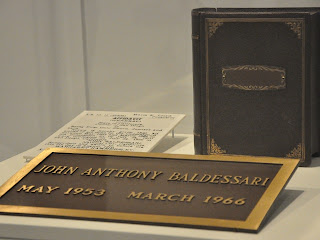
Image courtesy of DNAinfo/Jennifer Glickel


Pure Beauty was organized by LACMA in association with Tate Modern. It is on view at the MET until Jan. 9, 2011. For more information go here.

What I Drank:

Vodka. And a lot of it. I spent Friday night at a
big gay toys for tots benefit and it was open bar. Enough said.


What I Thought:

“Cremation Project” is a lasting testament to the transition in Baldessari’s career and creative process. Maybe the piece resonated so much because I’m in the process of my own career transition. And who hasn’t wanted to burn it all to the ground before.

Dallas

What I Saw:

The Dallas Museum of Art

My first time to the DMA, I was extremely impressed with the facilities, the diversity of the permanent collection and the breadth of community programming.

For visitor information, go here.

Standout Pieces from Re-Seeing the Contemporary (Oct. 15, 2010 - March 20, 2010):

David Szafranski's “Is it Fear or Desire” and Alan Saret's "Deep Forest Green Dispersion"


Deep Forest Green Dispersion, 1969, Alan Saret, American Galvanized hex netting, painted,Dallas Museum of Art, gift of John Weber


What I Drank:


What didn’t I drink?! Delicious margaritas at an excellent authentic Mexican restaurant, bottle after bottle of assorted red wines (bought in a slightly dream like shopping spree at Costco) and Miller Light. From a bottle and from a keg.

What I Thought:


Texas gets a bad rap.